To enroll,
please go to
http://www.calvert.com/foundation/cdfitraining.doc,
complete the attached registration form and submit it either by fax c/o Richard
Glod at 301.654.7820 or email it to richard.glod@calvert.com. This session will
be held via conference call and presentation materials will be sent by mail.
For more information, please email richard.glod@calvert.com or call
301.961.4771.
Calvert
Foundation is a nonprofit corporation whose mission is to increase community
investment. Calvert Foundation raises investments from the general public and
makes investments in community development loans funds, community development
credit unions and community development corporations. Calvert Foundation
currently has over 2000 investors and manages over $70 million in assets.
******************
NATIONAL CONGRESS FOR COMMUNITY ECONOMIC DEVELOPMENT (NCCED)
"Building the Next Generation of Community Economic Development Leaders"
MARCH 5-10, 2004
Washington,
D.C.
The Emerging
Leaders Program (ELP) is a unique leadership development program open to
undergraduate and graduate students as well as recent graduates from colleges,
universities, community colleges and trade schools. The ELP brings together
students and practitioners each year to learn more about the diverse and
exciting field of community economic development (CED). The ELP is a part of
NCCED's Human Capital Development Initiative (HCDI) to create a "talent
pipeline" of CED leaders and professionals.
Emerging Leaders:
* Attend the
national NCCED Policy Conference.
* Participate in leadership workshops.
* Increase knowledge base of CED industry and opportunities.
* Build a professional network.
* Become a member of NCCED's alumni association.
* Opportunity to apply to NCCED's Internship Program for a
paid internship position with a community development corporation (CDC).
* Visit
Capital Hill and meet Legislators.
* Make new friends with similar professional interests.
For program
information and application material, please log on to our website at
www.ncced.org (click on programs)
Extended
Deadline: Applications due December 31, 2003
National Congress
for Community Economic Development
1030 15th St., NW, Suite 325
Washington, DC 20005
202-289-9020
sklukas@ncced.org
The National
Congress for Community Economic Development (NCCED) is the trade association and
advocate for the community-based development industry. Founded in 1970, NCCED
represents over 3,600 CDCS across America. CDCs produce affordable housing and
create jobs through business and commercial development activities. NCCED
services the community development industry through public policy research and
education, special projects, newsletters, publications, trainings, conferences,
and specialized technical assistance.
www.ncced.org
******************
THE
FIRST VIETNAMESE-AMERICAN NGO CONFERENCE
May 7 - 9, 2004
Asilomar
Conference Center
Pacific Grove,
California
The Planning
Committee – Pacific Links Foundation (www.pacificlinks.org),
East Meets West Foundation (www.eastmeetswest.org),
VN21 and SAP-VN (www.sap-vn.org)
– is delighted to announce the First Vietnamese-American NGO (VA-NGO)
Conference, to be held on May 7 -- 9, 2004 at the Asilomar Conference Center in
Pacific Grove, California.
Over the course
of this weekend-long conference we hope the participants will have the
opportunities to 1) network with other Vietnamese-American NGOs, 2) share with
each other our experience with implementing projects and programs in Vietnam, 3)
help each other to improve our organizational capacity, including fundraising
and 4) find ways to improve our sustainable development advocacy work on behalf
of the people of Vietnam and within the overseas Vietnamese communities.
The VA-NGO
Conference will be held from
12 noon
Friday, May 7 through
12 noon Sunday, May 9, on the edge of the
Pacific Ocean. We
encourage all interested participants to attend the full conference.
Registration, detailed program and agenda and logistical information are
forthcoming.
To help us plan
the agenda, please provide us with your feedback and details on the following:
Brief
one-paragraph description of your organization
Full contact
information:
Street Address or P.O. Box
City, State, Zip
Phone
Fax
E-mail
Website
Highlight
projects or programs that you have funded or implemented
List of three
things that you would like to learn or achieve from this conference
We would like to
extend this invitation to organizations and groups that fund, support or operate
projects in Vietnam which were founded or currently directed by
Vietnamese-Americans. Please join us at this first national gathering to
showcase our commitment to the work that we do and to explore effective ways to
enhance our program and resource development capacity.
For more
information about the VA-NGO Conference, please call Sonny Le at the East Meets
West Foundation at 510-763-7045 or email us at
va-ngo-conf@sbcglobal.net.
******************
Funding Opportunities
Grants Help At-Risk Girls
(http://www.womenssportsfoundation.org/cgi-bin/iowa/funding/featured.html?record=30)
The
Women's Sports Foundation provides grants to nonprofits that combine sports
programs with educational information to reduce risky behaviors among girls ages
10 to 14.
The deadline for grants in the next round of the GoGirlGo grant program is Nov.
30. A total of $400,000 will be awarded.
Eligible nonprofits must demonstrate the ability to deliver sports programming
to girls through programs lasting eight weeks or longer. In addition, the
nonprofit must commit to participating in the GoGirlGo educational curriculum.
Complete program guidelines and application forms are available on the Women's
Sports Foundation's
website.
******************
Service Grants Available to
Nonprofits
(http://www.taprootfoundation.org/npo/criteria.shtml)
Nonprofits
with budgets under $5 million that are located in the New York and Bay Area are
eligible to apply for 2004 service grants offered by the Taproot Foundation.
The Service Grant program provides marketing and technology capacity-building
support to nonprofits. In this round of funding, four types of grants are
available: Branding and Identity; Brochure; Website; and Donor Database.
The application deadline is Dec. 1. Applications and additional information are
available on the Taproot Foundation's
website.
******************
Grants Available for
Work on Youth-Policy Issues
(http://www.aypf.org/)
Professionals who work on youth policy issues at the national, state and local
levels are invited to apply for fellowships through the
American Youth Policy Forum (AYPF).
The AYPF, based in Washington, D.C., is a nonprofit professional-development
organization that provides nonpartisan learning opportunities for individuals
working on youth-policy issues.
Its Harold Howe II Fellowships are awarded each year to promising young scholars
or practitioners. Fellows work on a self-designed project addressing significant
issues in youth policy, practice, research, or program evaluation, focusing
particularly on disadvantaged youth.
Fellows will receive a stipend of $25,000 and join the AYPF staff for 12 months.
The application deadline is Jan. 9, 2004. Application information is available
online.
(http://www.aypf.org/whatsnew.htm)
******************
Program Targets
Community Leadership Training
The Pew Partnership for Civic Change: LeadershipPlenty
(http://www.pew-partnership.org/programs/leadershipPlenty/index.php)
The Pew
Partnership for Civic Change LeadershipPlenty program is a training program
aimed at strengthening community leadership by equipping citizens to take
effective civic action. Selected partner organizations are provided with the
LeadershipPlenty Training Program, "train-the-trainer" instruction through an
intensive training institute, limited technical assistance with implementation
of the program, and involvement with other partners in the LeadershipPlenty
Network to refine the program and share strategies. Groups eligible to apply for
the program include national organizations with local affiliates, national
foundations, community foundations or regional organizations, local community
organizations, and universities and colleges. Applications are due December 31,
annually. Visit the above website for more information and application
instructions.
******************
Support to Prevent and
Alleviate Hunger
Food Industry Crusade Against Hunger: FOOD FOR ALL
(http://www.foodforall.org/)
The FOOD FOR
ALL program is an effort of the food industry to alleviate hunger and
malnutrition by fostering long-term, self-help solutions in the United States
and around the world. Nonprofit organizations in California, Colorado, Idaho,
Illinois, Indiana, Iowa, Montana, Nebraska, Nevada, New Mexico, Oregon, Utah,
Washington, Wisconsin, and Wyoming are eligible to apply. The program provides
support to build community food security, develop individual and family
self-reliance, and create employment opportunities. Grants generally range from
$1,000 to $10,000. Applications are due February 3, annually. Visit the above
website for more information.
******************
Start-Up Funds for Interfaith Community Volunteer Caregiving Programs
The Robert Wood Johnson Foundation: Faith in Action
(http://www.fiavolunteers.org/)
Faith in
Action is an interfaith volunteer caregiving program that brings together
religious congregations of all faiths and other community organizations such as
hospices, clinics, and hospitals, in a common mission to provide volunteer care
to neighbors with long-term health needs. The program, funded by the Robert Wood
Johnson Foundation, offers start-up grants of up to $35,000 to help communities
organize new coalitions for volunteer caregiving. In addition to providing
start-up grants, the Faith in Action national office offers technical support
and advice on how to develop successful, sustainable caregiving programs that
can serve communities for many years. Application deadlines are February 1, June
1, and October 1, annually. For more information, or to access application
instructions, visit the above website.
******************
Funds for Teaching Tolerance
Southern Poverty Law Center: Teaching Tolerance Grants
(http://www.tolerance.org/teach/expand/gra/guide.jsp)
The Teaching
Tolerance project of the Southern Poverty Law Center offers grants of up to
$2,000 to K-12 classroom teachers across the nation to implement tolerance and
youth activism projects in their schools and communities. Grants target
activities that promote acceptance of diversity, peacemaking, community service,
or any other aspect of tolerance education. Proposals from other educators, such
as community organizations and churches, will be considered on the basis of
direct student impact. Applications are accepted year-round. Visit the above
website for more information and to access application forms and guidelines.
******************
Community Support from
the Gannett Foundation
Gannett Foundation
(http://www.gannettfoundation.org/)
The Gannett
Foundation provides support to nonprofit organizations that serve the
communities in more than forty states where Gannett Co., Inc., owns a local
daily newspaper or TV station. For a list of Gannett communities go to
http://www.gannettfoundation.org/communities.htm. The majority of the
Foundation's community grants target grassroots organizations in the areas of
social and human services, and health and mental health. Other areas of interest
include education, arts and culture, and civic and community projects. Each
community has its own priorities in addition to the general guidelines of the
Foundation. Interested applicants should check with the local contact person to
see if the grant request fits with local funding preferences. Deadlines for
proposals to arrive from the local operations to Foundation headquarters are
February 15, May 15, and September 15, annually. Local deadlines are at least a
month earlier. Check with your community's Gannett operation for local
deadlines. For application procedures, local contact information, or more
information, visit the above website.
******************
Awards to Support Art Exhibitions
Emily Hall Tremaine Foundation: Exhibition Awards
(http://www.tremainefoundation.org/art/default.asp)
Through the
Exhibition Award program, the Emily Hall Tremaine Foundation rewards innovation
and experimentation at the curatorial level, supporting exhibitions that
challenge audiences and the mainstream of Contemporary Art. Curators, partnered
with an established nonprofit exhibition space, are encouraged to apply for the
award to develop thematic concepts that they have always dreamed of. Awards of
up to $100,000 are granted. Application guidelines will be available in November
2003 through the Foundation's website and applications will be due
April 16, 2004. Visit the above website for more information.
******************
Tips
Early Insights on Faith-Based Civic Engagement from the Organized Religion
Initiative
Americans
have always felt ambivalent about the role of religion in public life, yet its
influence in shaping policy can be traced from the beginnings of the Republic.
Today we live in a time when more and more Americans feel alienated by or
excluded from public life. After decades of secularism, religion is now
recognized as a powerful force in public life, for good or possibly ill, from
Iraq to the White House.
(http://www.irvine.org/IQ3.1_grant.htm)
******************
Eyes
Wide Open: Deciding When to Launch a Community Initiative
Imagine for
a moment that you are a staff member of a community foundation, and a program
officer from a private foundation calls with a tantalizing offer of funding for
a special community initiative on after-school programs. Or, that you are
approached by a group of community members who are concerned about problems
facing the local economy, and they ask your community foundation to take on the
issue as a major community project. How do you choose the best course of action?
A new publication helps you make the decision.
(http://www.irvine.org/IQ3.1_publications.htm)
******************
Easy Voter Guide:
Providing Californians with Accessible Voter Information
Politics in
California has never been a hotter topic, and it is more important than ever
that all California citizens vote. The “Easy Voter Guide” Project is based on
the simple premise that all people should have access to user-friendly
information to help them get involved in our democratic process. The
community-designed guide provides nonpartisan information about how to
vote and what is on the ballot for traditionally underserved audiences in
California as well as for the general public.
(http://www.irvine.org/IQ3.1_useit.htm)
******************
Website Offers Resources for Affordable Housing and Community Development
Fannie Mae Foundation: KnowledgePlex®
(http://www.knowledgeplex.org/)
KnowledgePlex, a
collaborative effort created by the Fannie Mae Foundation and supported by a
team of founding partners, has recently launched its redesigned website to
assist the efforts of practitioners, grantors, policy makers, scholars,
investors and others involved or interested in affordable housing and community
development. The website features a collection of publications including
research, case studies, best practices, scholarly articles, opinion pieces, and
other material related to the affordable housing and community development
fields; the latest housing and community development news stories from national
publications; the "Week in Review" e-newsletter summing up the weekly relevant
news; topical discussion forums for information exchange; and a calendar of
events for industry professionals. To access these resources, visit the above
website.
******************
CLINIC Announces
New Edition of Citizenship for Us
Catholic Legal Immigration Network, Inc. (CLINIC) is pleased to announce the 3rd
edition of Citizenship for Us: A Handbook on Naturalization and Citizenship.
This latest edition, published in August 2003, is updated for the recent
transition of the INS to the United States Citizenship and Immigration Services
(CIS) and includes updated information on new laws, forms, procedures, and
technologies. Citizenship for Us is a 346-page handbook that explains the N-400
(Application for Citizenship) and contains legal analysis of citizenship
eligibility, requirements, and benefits. It describes the naturalization
process in detail and contains many useful CIS forms and sample correspondence
from CIS. The handbook also contains 12 study units on
U.S.
history and civics with historic photos, time lines, vocabulary, and sample
tests. Wri tten by Aliza Becker, a best-selling author on citizenship, and
CLINIC staff, it is geared for immigrants, community leaders, social service
providers, and other non-attorneys. The cost is only $25.
To order the
handbook, call (202) 635-2556 or visit the CLINIC website at
www.cliniclegal.org.
Laura Burdick
Deputy Director for National Programs
Catholic Legal Immigration Network, Inc. (CLINIC)
(202) 635-5820
Translations of A
Guide to the Naturalization can be found at:
(http://uscis.gov/graphics/services/natz/guide.htm)
in Vietnamese –
(http://uscis.gov/graphics/services/natz/Vietnamese.pdf)
******************
Ten Tips for Successful
Pre-Service Training
(from the MOSAICA Training Briefs newsletter)
A
successful pre-service training or orientation is the key to starting the
program year off strong. This is the first opportunity for members to see the
program in action; set realistic expectations; form partnerships with other
members, program staff, and site supervisors; and begin building a strong sense
of team (or esprit de corps). AmeriCorps members need to develop a
foundation, a functional level of general and project specific knowledge and
skills, in order to feel comfortable and confident in their new roles, and
effectively serve their community. A strong foundation laid during pre-service
training can help ensure a smooth year (effective and happy members) and be
built upon during in-service sessions throughout the year. If the foundation is
not strong, it will need reinforcing. Ineffective pre-service training will
create challenges and leave program staff, and members, playing catch-up for the
rest of the year. Investing in effective training up front pays off later.
The following tips will help AmeriCorps programs prepare for member pre-service
training or orientation.
1.
Plan.
The better organized you are, the better the orientation will be -- even if you
make lots of changes during the session. The more you systematically consider
possible situations and needs, methods and potential problems, the more
confident and flexible you will be.
2.
Make your orientation outcome-based.
Instead of designing your orientation based on topics to include, decide what
outcomes you want to accomplish. Then pick topics and methods that will generate
these outcomes. Often, one activity can contribute to several outcomes.
3.
Make your pre-service training truly interactive and experiential. That
means more than time for question and answer. Use every component of the
experiential learning model (Starting Strong,p. 85) -- and keep in mind
the learning pyramid (Starting Strong, p. 88). The greater the active
participation of the members, the greater the retention.
4.
Carefully choose, and thoroughly prepare, your facilitators and presenters.
Select them for their training skills, not just their content knowledge. Be sure
they know what you expect, and review materials and methods before the training.
For experts who aren't trainers, use them as "resources," and facilitate the
session yourself.
5.
Emphasize teamwork.
Most participants will be working in teams. Use icebreakers, well-designed
small-group activities, special teambuilding activities, and community projects
to build team spirit and mutual trust.
6.
Model the service ethic.
Bring in role models, build on individual eagerness to serve, and have the
staff, site supervisors, and other presenters reflect the benefits of service.
Talk about service directly and honestly, and communicate realistic
expectations.
7.
Use participants as resources.
Assess their skills as well as their training needs. Give them opportunities to
teach each other, through cooperative learning groups (Starting Strong,
pp. 197) and other specific peer teaching activities. Use them as
co-facilitators in areas in which they have special expertise.
8.
Link training with the service assignment.
Train the supervisors as well as the members. Have supervisors work with members
to plan their service activities. Provide or plan community projects. The more
relevant the orientation to the actual assignment, the more interesting and
useful it will be for members.
9.
Monitor, assess, and evaluate.
Throughout the session, ask members for feedback, and make immediate
refinements. Assess specific activities and the overall session as a basis for
change next year. Follow up to see if skills learned are retained and used. Use
varied evaluation techniques.
10. Make pre-service training the first step in ongoing learning.
Link it to in-service sessions, site-based training, and other knowledge and
skill development opportunities.
(http://nationalserviceresources.org/resources/online_pubs/training/trainingbriefs_2.php)
******************
The Personal Touch:
Training the Team Yourself
Maybe you’ve
searched for a trainer and no one is available to train your members or
volunteers on a particular day. Maybe you know the subject matter better than
anyone else. Maybe you want the experience of training your team yourself so you
can handle questions that arise or convey the information precisely.
Whatever the
reason, there will likely come a time when you as program coordinator or staff
member will be responsible for training your members or volunteers. It does not
have to be a daunting experience. The trainer’s responsibility is to facilitate
the learning of information through activities and discussion. Don’t think you
have to lecture. In fact, it’s better if you don’t. By being prepared and
planning creative activities for participants to learn from, your job as trainer
will be easier and participants will walk away with the skills they need.
(http://nationalserviceresources.org/filemanager/download/294/training.pdf)
******************
News
November 5,
2003
ELECTRONIC BALLOT
ESlate voting proves smooth,
not flawless
By ERIC
BERGER
Houston Chronicle
Voting at
663 polling stations in Houston and the rest of the Metropolitan Transit
Authority area using eSlate machines went smoothly Tuesday, elections officials
said.
"In general
I think it went very well," said Harris County Clerk Beverly Kaufman. "I think
our people in the field did a very good job."
Very good,
perhaps, but not flawless. Greater True Light Baptist Church, a northeast
Houston polling site, did not open until about 9 a.m. An election worker there
had difficulty setting up the equipment, and did not call for help quickly
enough, Kaufman said. Between 50 and 100 voters were turned away.
"The concern
is that they would not be able to get back in time," said U.S. Rep. Sheila
Jackson Lee, D-Houston, of the predominantly African-American district. "Their
voting rights are being impinged upon. It's a severe problem."
Lee
discussed with Sylvester Turner's mayoral campaign staff the possibility of
getting a court order to keep the polling site open two more hours, but chose
not to because the problem appeared to be isolated.
"If we would
have had a widespread situation I would have been over there myself in front of
a judge asking to extend the hours," said Kaufman, who cannot keep a polling
place open late on her own authority.
At the
Holiday Inn Hotel at 7787 Katy Freeway, election workers decided to use paper
ballots when they thought the eSlate voting machines were not working properly.
About 75 makeshift ballots were cast -- and signed.
But the
eSlates were not malfunctioning. Workers were entering incorrect information
into the machines that assigned the wrong ballots to voters. David Puckett, who
showed up shortly after 7 a.m., at first registered his vote on a piece of
paper, but returned later to cast an eSlate ballot, concerned his initial vote
might not be counted.
"This isn't
Houston's finest moment," he said. "You had to see it to believe it. Really, no
one knew what to do."
Elections
officials said they would ensure that only one vote per person would be counted.
Part of the
confusion at the west Houston location and others is the distinction between the
Houston and Metro voting areas. All of Houston is in Metro, but the Metro area
extends well beyond the city limits.
In some
polling precincts, one voter might be eligible to vote in the Houston elections,
such as mayor, and on the rail referendum, but another voter might only be able
to vote for or against rail. At other polling precincts, some people were
eligible to vote in the rail referendum, while others, residing outside the
Metro area, were not.
Donna Mabry,
who lives just outside the city and Metro areas near Ellington Field, said she
and other residents from SageGlen subdivision were surprised when they were
turned away from the polls.
"Now I know
how those poor people in Florida felt," Mabry said, referring to problems there
in the last presidential election.
The county's
decision not to make the eSlate ballots available in Vietnamese did not seem to
faze most Vietnamese voters, who got bilingual friends and relatives to help
them vote.
At
Chancellor Elementary in Southwest Houston, Gary Phan stood at the booth to help
his 70-year-old mother with the new electronic ballot.
"It's not
easy for her to understand the English," Phan said of his mother, Lu Thi Dong.
"She has been voting for four years, and I always help her."
City
officials believe the precinct voting at Chancellor, on Boone near Bellaire, has
the highest Vietnamese population of any in Houston. Two translators stood by to
help, but they said they were not busy, since most Vietnamese preferred to use
relatives to translate.
"We haven't
had any problems," said Hieu Binh, one of the translators.
Some
precincts refused to let Vietnamese voters use their own translators. At All
Saints Lutheran Church on West Bellfort, election officials insisted Vietnamese
voters work with translator Chan Ho.
"The
translator is supposed to be helping them, not the family member," said Precinct
649 Alternate Judge Ruth Duson-Phillips.
Ho said the
lack of a Vietnamese version of the ballot made it more difficult for about 20
voters in the precinct.
Kaufman said
it is not only legal for a voter to get someone -- other than their employer or
union boss -- to help understand a ballot, it is encouraged.
Chronicle
reporters Salatheia Bryant, Ed Hegstrom and Bill Murphy contributed to this
story.
(http://www.chron.com/cs/CDA/ssistory.mpl/ec/nov4/2201121)
******************
November 17,
2003
The U.S.
Equal Employment Opportunity Commission
FOR
IMMEDIATE RELEASE CONTACT: David Grinberg
Monday,
November 17, 2003 (202) 663-4921
James Ryan
(202) 663-4965
(202) 663-4900
TTY: (202) 663-4494
ISHIMARU TAKES OATH AS EEOC
COMMISSIONER
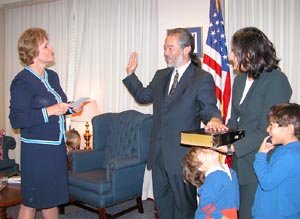
Stuart J. Ishimaru is sworn in as an EEOC Commissioner by Chair Cari M.
Dominguez, as his wife and children look on.
Commission Has Full Five Members For
First Time Since 1996
WASHINGTON -
Stuart J. Ishimaru was sworn in today as a Commissioner of the U.S. Equal
Employment Opportunity Commission (EEOC), bringing the bi-partisan panel to its
full five-member status for the first time in seven years. Mr. Ishimaru was
nominated by President Bush on October 14, 2003, and unanimously confirmed by
the full U.S. Senate on October 31 to fill the remainder of a five-year term
expiring in July 2007.
"In his
varied and distinguished career, Stuart Ishimaru has demonstrated a lifelong
commitment to equal opportunity and civil rights," said EEOC Chair Cari. M.
Dominguez. "We are delighted to have his many talents committed to furthering
the mission of our agency. We welcome Commissioner Ishimaru and look forward to
working with him."
Mr. Ishimaru
joins Chair Dominguez, Vice Chair Naomi C. Earp, and Commissioners Leslie E.
Silverman and Paul Steven Miller on the five-member Commission. Commissioners
are appointed for five-year, staggered terms with the President designating a
Chair as the chief executive officer of the Commission, as well as a Vice Chair.
The five-member Commission makes equal employment opportunity policy and
approves most litigation in consultation with the General Counsel (also a
presidential nominee). The current General Counsel is Eric Dreiband.
"I am
honored and excited to be joining the Commission," said Mr. Ishimaru. "For
nearly 40 years the EEOC has been at the forefront of our nation's commitment to
root out illegal discrimination. I look forward to working with my colleagues at
the Commission to make this vision a reality."
Mr. Ishimaru
previously served as Deputy Assistant Attorney General in the Civil Rights
Division of the U.S. Department of Justice between 1999 and 2001, where he
supervised litigation involving employment, disability, and housing
discrimination, and criminal prosecutions of civil rights laws. Prior to that,
he served as Counsel to the Assistant Attorney General for five years, advising
Assistant Attorneys General on policy and political matters.
In 1993, Mr.
Ishimaru was appointed by President Clinton to be the Acting Staff Director of
the U.S. Commission on Civil Rights, and from 1984 to 1993 served on the
professional staffs of the House Judiciary Subcommittee on Civil and
Constitutional Rights and two House Armed Services Subcommittees of the U.S.
Congress. A native of San Jose, Calif., he received his undergraduate degree
from the University of California, Berkeley, and his law degree from the George
Washington University.
The EEOC is
the federal agency charged with enforcing Title VII of the Civil Rights Act of
1964, which prohibits employment discrimination based on race, color, religion,
sex (including sexual harassment or pregnancy) or national origin and protects
employees who complain about such offenses from retaliation; the Age
Discrimination in Employment Act of 1967, which protects workers age 40 and
older from discrimination based on age; the Equal Pay Act of 1963, which
prohibits gender-based wage discrimination; the Rehabilitation Act of 1973,
which prohibits employment discrimination against people with disabilities in
the federal sector; Title I of the Americans with Disabilities Act, which
prohibits employment discrimination against people with disabilities in the
private sector and state and local governments; and sections of the Civil Rights
Act of 1991. Further information about the Commission is available on the
agency's web site at
www.eeoc.gov.
(http://www.eeoc.gov/press/11-17-03.html)
******************
November 20,
2003
Congress Studies Why Women Earn
Less
Associated Press
WASHINGTON -
Women's income is lower on average than that of men in part because they
generally work less, leave the labor force for longer periods and tend to hold
jobs that pay less, a congressional study found.
But even
after adjustments are made for those factors, women still earned an average of
20.3 percent less than men in 2000, investigators said Thursday.
The General
Accounting Office conducted the earnings study for Democratic Reps. Carolyn
Maloney of New York and John Dingell of Michigan.
The 20
percent gap has been relatively unchanged in the past two decades. The
difference was 19.6 percent in 1983.
The study
could not explain reasons for the earnings difference, but noted that experts
have speculated it could be due to discrimination or the decision by some women
to forgo career advancement for family-friendly jobs that offer more flexibility
and less stress.
"These
decisions may have specific consequences for their career advancement or
earnings," the study said. "However, debate exists about whether these decisions
are freely made or influenced by discrimination in society or in the workplace."
Maloney and
Dingell want to create a research center at a public university that would study
potential solutions and publish information for employers and employees.
"After
accounting for so many external factors, it seems that still, at the root of it
all, men get an inherent annual bonus just for being men," Maloney said. "If
this continues, the only guarantees in life will be death, taxes and the glass
ceiling. We can't let that happen."
Men work on
average 2,147 hours per year, compared with 1,675 for women, the study said.
Almost nine
of 10 men worked full time compared with two of three women. Men were out of the
labor force an average of one week compared with three weeks for women, the
report said.
The influx
of women in the labor force in recent decades has failed to result in
significant changes at the office, the study said.
"Research
suggests that many work places still maintain the same policies, practices and
structures that existed when most workers were men who worked full time,
40-hours per week," the report said. "As a result, there may be a mismatch
between the needs of workers with family responsibilities and the structure of
the workplace."
(http://www.bayarea.com/mld/mercurynews/7309076.htm)
******************
November 22,
2003
Police auditor urges changes
ACTIVE ROLE SOUGHT IN SHOOTING PROBES
By Roxanne Stites
Mercury News
San Jose's
independent police auditor recommended that the department's shooting review
panel be more rigorous and accountable when determining whether it needs to
improve training following shootings by officers. She also recommended a larger
role for herself in investigating cases where officers shoot civilians.
The current
system is inadequate, said auditor Teresa Guerrero-Daley in her regular
six-month report released Friday. She said routine complaints, most of which
don't involve severe injury, usually receive more scrutiny than fatal shootings.
The shooting
review panel -- set up in 1999 with members including the police chief, auditor
and other top police administrators -- doesn't independently investigate
incidents, Guerrero-Daley said, but instead relies almost exclusively on a
detective's report. Also, there is no documentation of the panel's discussion
and members often leave without clear decisions on what should be changed or
reinforced in police training to prevent future shootings.
Expanded role
She
recommended that the panel be able to call witnesses and ask questions in
shooting cases -- similar to the way the auditor investigates other complaints.
``At least
then,'' she said, ``we could say we conducted a thorough, independent review. As
it is right now, it's very limited.''
Her
recommendations follow by four months a highly emotional and widely publicized
case in which a San Jose officer shot and killed a young Vietnamese mother, Bich
Cau Thi Tran, in her home after she allegedly waved an unfamiliar kitchen
implement at him. Guerrero-Daley said, however, that her recommendations do not
stem from a particular case, but from a review of shootings by officers from
1993 to 2002. The officer in the Tran case was cleared by a grand jury of
criminal wrongdoing.
Guerrero-Daley made similar recommendations in 1999, a record year for shootings
by officers. The solution then was to convene the review panel, but she said she
has since realized that hasn't solved all of the problems.
San Jose
police would not comment on specific recommendations until the department
analyzes them and presents its opinion to city council members Dec. 2.
Guerrero-Daley, auditor since 1993, also wants a bigger role in investigating
shootings by officers.
Immediate response
She wants to
be called out immediately to police shooting scenes. Typically, the auditor
starts her review three to five months after the shooting. She said police
officials have been reluctant to give her access, fearing she'd contaminate
evidence or be called as a witness. She said other cities that have auditors on
scene have experienced no problems.
In her
17-page report, the auditor also commended the department for making strides
toward decreasing the number of shootings. There were 10 shootings in 1999,
eight of them fatal, but none last year.
There have
been two this year, including Tran. That shooting prompted public outcry and led
to a rare, open grand jury hearing. While the officer was cleared,
Guerrero-Daley said lessons could be learned from that shooting and others.
Contact
Roxanne Stites at
rstites@mercurynews.com or (408) 295-3984.
(http://www.bayarea.com/mld/mercurynews/news/local/7326094.htm)
******************
November 23,
2003
Mystic Turtle in Need of a Miracle
Giant species
that stars in a Vietnamese folk tale faces extinction. Only one is believed to
remain in
Hanoi
lake.
By Margie
Mason, Associated Press Writer
HANOI —
There once was a magic golden turtle that lived in Hanoi's most enchanted lake.
A creature so powerful, it snatched a divine sword from a warrior king and
returned it to the gods of the depths nearly six centuries ago.
That tale has long been a favorite among young and old Vietnamese living in the
capital city, but folklorists may soon have to rewrite the story to include a
very sad ending.
That's because in real life, the last giant soft-shell turtle living in Hoan
Kiem Lake will probably die alone, and at least one biologist says the species
will then be extinct.
The elusive creature — with a shell as big as a desk — occasionally pokes its
wrinkled head out of the murky waters of the downtown lake to take a breath, but
few Vietnamese are lucky enough to glimpse it. And certainly no one knows its
age.
Scientists say it probably is the most endangered freshwater turtle species in
the world.
"This species is a huge, huge animal that's incredibly endangered and it really
needs help," said Anders Rhodin, co-chairman of the World Conservation Union's
Tortoise and Freshwater Turtle Specialist Group. "I don't think anyone is
willing to try to capture that animal in Hoan Kiem Lake. I think it is thought
to be sacred."
Conservationists are determined, however, not to let the legendary species die
out. This month, researchers from Hanoi National University and the U.S.-based
Wildlife Conservation Society plan to scout lakes in Thanh Hoa province, 100
miles south of Hanoi, where other giant turtles have been sighted, but never
confirmed.
"We're going to the province to see whether there's any truth to this," said
Douglas Hendrie, the society's Asia regional turtle conservation coordinator who
has worked in Vietnam since 1996. "The species is very, very, very important to
Vietnam culturally and therefore of high priority when it comes to
conservation."
Legend has it that in the mid-15th century, King Le Loi defeated Chinese
invaders with a magic sword given to him by the gods. After the victory, the
king was said to be boating on the lake when a giant golden turtle rose to the
surface and grabbed the sword in its mouth before plunging deep into the water
to return it to its divine owners.
The lake was later renamed "Ho Hoan Kiem," which means "Lake of the Returned
Sword," and the tale became an important part of Vietnamese culture that
continues to be taught in school and performed at popular water puppetry shows.
But just like the Loch Ness Monster or the Tasmanian Tiger, no mythical creature
comes without controversy. Vietnamese biologist Ha Dinh Duc, who has studied the
lone turtle since 1991, reported in 2000 that it was a new species and named it
Rafeteus leloii after the king.
Other scientists dispute his conclusion, saying at least five other turtles of
the same species, Rafeteus swinhoei, have been found in zoos and a
monastery in neighboring China.
But Duc, who vows to study the turtle for the rest of his life, said no one has
spent more time researching and viewing it than he has.
"There's no other types of turtle like this in other countries," Duc said.
"Their assessment is totally wrong."
As he slid his wire glasses up his nose and rifled furiously through years of
yellowed papers and stacks of color photos, he spoke about the turtle like a
child.
It weighs about 440 pounds and its massive shell stretches 6 feet long and 4
feet wide. Its gender remains a secret along with its age because Duc says only
he has been lucky enough to view it completely out of the water a few times as
it rested on an island in the middle of the small, shallow lake.
Hendrie said the turtle could probably live up to 100 years, but Duc believes
that it's conceivable for the animal to be old enough for Le Loi himself to have
released it into the lake, which was once part of the Red River.
The World Conservation Union ranks the turtle as critically endangered, the most
threatened category, saying it is "perilously close to extinction" and
"currently probably the most endangered freshwater turtle in the world."
Its precarious circumstances mirror those of many turtle species, especially in
Asia. The organization says 74% of the continent's 90 freshwater turtle and
tortoise species are listed as threatened because of continuing demand for food
and traditional medicine.
Hendrie and Rhodin said they're optimistic about finding other giant soft-shell
turtles in the wild or placing the ones in China together in captivity to try to
save the species from extinction. Turtles remain fertile until death, so it's
possible for even very old animals to mate, but they said more research is
necessary before steps can be taken.
However, the prospects for the Hoan Kiem turtle, as it is known, look bleak. Duc
said three others like it emerged from the lake in the 1960s, but all of them
have died and all of the scientists agree that only one remains. One huge
stuffed specimen is displayed in a small temple on an island in the lake, but
not even Duc is bold enough to disturb the revered remaining creature that will
undoubtedly have its own legend centuries from now.
"No one is allowed to touch this turtle," Duc said, sitting by the water. "If
something went wrong, who would be responsible? It would be a big deal that
would impact the soul of a nation."
(http://www.latimes.com/news/printedition/asection/la-adfg-turtle23nov23,1,5665227.story)
******************
This Month in Immigration History – July 1975
From U.S.
Citizenship & Immigration Services, Dept of Homeland Security
The
war in Vietnam ended on
April 30, 1975. Over 130,000 Vietnamese left the country amid the final
moments of that war. Of these, some 65,000 Vietnamese military and government
officials and Vietnamese employees of the United States and their families were
considered "at risk" and were evacuated directly by the U.S. military; another
65,000 got out on their own in military aircraft, ships and boats. Most were
taken first to
Guam and then
resettled in the
United States.
(You will need the free
Adobe Acrobat Reader to access this link.) The last two Americans to die in
that war were lost late on April 29 when their CH-46 evacuation helicopter
crashed at sea near the USS Hancock, one of the navy ships receiving refugees.
They were en route back to the mainland to collect more refugees.
Some in the
United States reportedly thought that this initial wave would be all the
Vietnamese war-related refugees needing sanctuary in the
United States.
In fact, this evacuation, rather than an end, was merely the beginning of what
would become, during its 25-year history, one of the longest-running migration
and refugee resettlement programs in the modern era. In the end, some 3 million
people left their homes in the former French
Indochinese colonies of
Vietnam,
Laos, and Cambodia, including 1.75 million Vietnamese land refugees and boat
people. They found resettlement, mostly in Western countries and Australia. Of
these, the
United States East Asian Refugee Admissions Program resettled over 1.4
million Indochinese refugees, including some 900,000 from Vietnam. Countless
thousands more lost their lives leaving Vietnam in rickety boats -- only to be
preyed upon by pirates, battered by rough seas, and, at times, devastated by an
inability to land in friendly territory.
Responding to
this migration and its evolution over time ultimately required two international
conferences, permutations of traditional refugee definitions, extraordinary new
protection measures, massive assistance programs, and large-scale resettlement
efforts.
The first of
these international conferences was the July 20-21, 1979, (International) Meeting on Refugees and Displaced Persons in
Southeast
Asia. One of the main movers behind the conference was reported to be British
Prime Minister Margaret Thatcher: she was anxious to relieve the pressure and
expense of caring for Vietnamese boat people on Great Britain's then colony,
Hong Kong. The July conference was the first attempt to address this migration
in a systematic and comprehensive manner. This is a brief summary of the events
leading to that conference, the agreements reached at it, and the consequences
that resulted from it.
[Click on link
below to read more.]
(http://uscis.gov/graphics/aboutus/history/july79.htm)
******************
Legislation
H.R.3295
– Help America Vote Act
Title: A bill to require States and localities to meet uniform and
nondiscriminatory election technology and administration requirements applicable
to Federal elections, to establish grant programs to provide assistance to
States and localities to met those requirements and to improve election
technology and the administration of Federal elections, to establish the
Election Administration Commission, and for other purposes.
Sponsor: Rep Ney, Robert W. [OH-18] (introduced
11/14/2001) Cosponsors: 172
Related Bills:
H.CON.RES.508, H.RES.311, S.565
Latest Major Action:
10/29/2002 Became
Public Law No: 107-252.
Update:
November 26, 2003
SENATE
WRANGLING BLOCKS FUNDS, LEADERSHIP FOR ELECTION OVERHAUL
Congressional
Quarterly
The fight over
the omnibus spending bill is holding up $1.5 billion to help states meet new
federal election standards. But the money is not the only casualty of the raging
partisan wars in the Senate. The four nominees to the commission authorized to
distribute the funding are caught up in a spat between Senate Republicans and
Democrats over other Bush administration nominees. Senate Majority Whip Mitch
McConnell, R-Ky., took the floor yesterday to complain that "another round of
obstructionism" by Democrats had prevented the Senate from confirming Bush
nominations, leaving 95 nominees hanging -- including those for the election
commission. Frustrated state officials say it may already be too late to get new
equipment in place and make other major improvements in time for the 2004
elections. Denise Lamb, New Mexico's director of elections and president-elect
of the National Association of State Election Directors, said, "It's mystifying
that we've been giving these deadlines and yet [lawmakers] are hamstringing us."
******************
About NCVA
Founded in 1986,
the National Congress of Vietnamese Americans is a 501(c)(3) nonprofit community
advocacy organization working to advance the cause of Vietnamese Americans in a
plural but united America – e pluribus unum – by participating actively
and fully as civic minded citizens engaged in the areas of education, culture
and civil liberties.
Visit us at
www.ncvaonline.org.